

 By
By 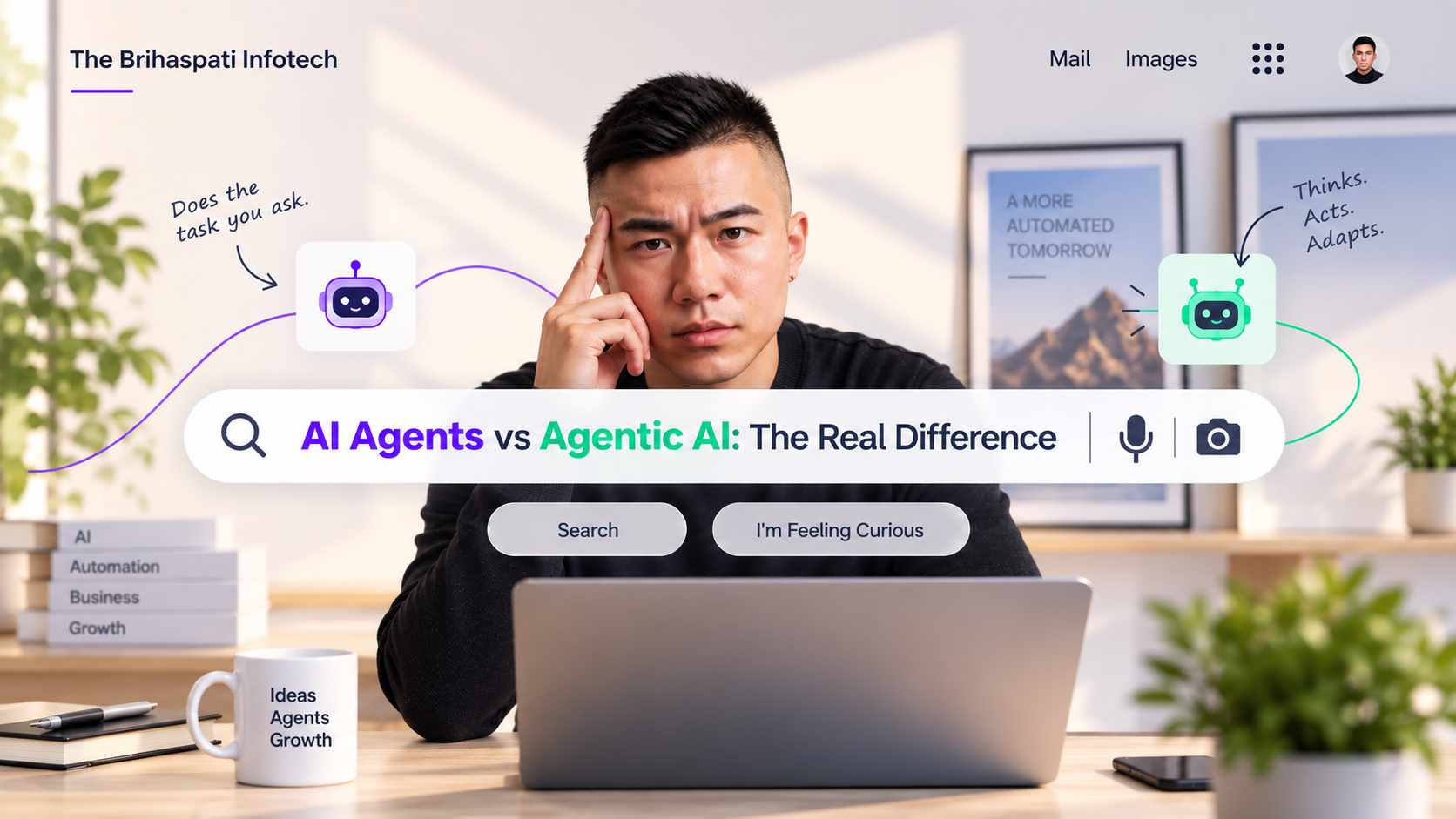
- An AI agent is task-specific. It’s built to handle one job well, within a defined boundary, like routing a support ticket or pulling a record from a CRM.
- Agentic AI is goal-oriented and autonomous. It plans multi-step actions, adapts as conditions change, and often coordinates several agents toward a larger outcome.
- Scope is the core difference. AI agents operate within fixed programmatic boundaries, while agentic AI manages complex, end-to-end workflows across multiple systems.
- Neither approach is universally better. Task-specific agents are cheaper, faster to deploy, and easier to audit, while agentic AI suits dynamic, cross-functional processes.
- Most real deployments in 2026 use both. Task-specific agents handle high-volume, repeatable work, while agentic AI orchestrates the more complex processes around them.
- Governance needs differ sharply. Agentic systems require outcome-level policy frameworks, not just task-level rules, since they make more decisions independently.
- The Brihaspati Infotech designs the right mix for each business, rather than defaulting to whichever term sounds more impressive in a sales deck.
THE FOUNDATION
What Exactly Is An AI Agent
An AI agent refers to a software program capable of perceiving its environment, making decisions, and performing actions to accomplish a particular task. A rational agent is programmed to perform a certain action within a limited or predefined set of actions.
In other words, an AI Agent can be compared to a specialist and not a strategist. For example, a chatbot that directs customer support inquires based on specific wards is an AI agent. Similarly, a system that helps pull a customer’s file and update a certain detail qualifies as an AI agent. The software does not necessarily undertake multiple tasks to attain a broad objective.
01
Narrow scope
built for one job, not a whole process
02
Fixed boundaries
operates within rules set by its designers, rather than improvising new strategies
03
Fast and cheap to deploy
easier to build, test, and audit because the task is small and well-defined
04
Predictable behavior
easier to trust in production, since there’s less room for the system to go off-script
Since an AI agent focuses on a specific activity, it is a good starting point for businesses venturing into automation for the first time. It also requires fewer governance rules and is easier to achieve higher-level AI systems.
For instance, The Brihaspati Infotech recommends starting with AI agents when addressing a recurring high-level business activity that needs to be automated for increased efficiency. The return on investment starts flowing immediately after deployment.
THE BROADER SYSTEM
What Exactly Is Agentic AI
Agentic AI refers not to one tool but rather a whole class of systems. One agent is not solving one problem in isolation, but rather multiple agents are working together with autonomy and persistence to solve a larger one.
Systems that exhibit agentic qualities perform multi-step planning and execute them, can act autonomously and persistently towards a solution, and have some form of coordination either built in or achieved by using other agents that have these same capabilities to a lesser degree.
Overall, such systems focus on goals rather than tasks, involve few decisions from the operator, and include coordination and planning.
01
Goal-oriented, not task-oriented
the system pursues an outcome, not just a single completed action
02
Multi-step planning
it reasons through what needs to happen next, adjusting as new information arrives
03
Coordinates multiple agents
smaller, specialized agents often work underneath a larger agentic system
04
Operates with minimal oversight
decisions get made independently, based on policies set in advance
An example of such software in action would be an automated subscription cancellation system. The system would need to confirm the cancellation request, check if the user is eligible, apply any retention offers, and cancel the subscription.
It would have to perform these steps in some order depending on specific circumstances. This is a decidedly more complex variation of a branching process than the usual if-then statements used in programming.
THE COMPARISON
The Core Difference Between AI Agents And Agentic AI
The easiest way to summarize the difference between the two approaches in one sentence, AI agents are task-specific, while agentic AI is autonomous. Both solutions have their advantages and shortcomings, but the choice depends on the task’s complexity a company wants to delegate to machines.
The table below summarizes the key characteristics of the two solutions, which should help distinguish between them.
| Factor | AI Agents | Agentic AI |
| Operational scope | Narrow, single task, focused on one clearly defined job within one system | Broad, end-to-end workflow, spanning multiple systems, teams, and connected steps |
| Decision autonomy | Follows fixed rules or learned behaviors set in advance, with little room to deviate | Plans multi-step actions and adapts independently as conditions change mid-workflow |
| Coordination | Works alone, completing its one task without needing input from other agents | Orchestrates multiple specialized agents at once, coordinating them toward one shared goal |
| Deployment speed | Fast and low effort, since the scope is small and the logic is straightforward to build | Slower, requiring more upfront design work to map dependencies and decision points |
| Cost to run | Lower, since less reasoning, memory, and tool access is needed to complete the task | Higher, due to added complexity, more compute, and ongoing coordination overhead |
| Governance needs | Task-level rules, usually a simple set of boundaries the agent isn’t allowed to cross | Outcome-level policy frameworks, defining what can be decided autonomously and what needs approval |
| Auditability | Easier to audit, since the logic is linear and every action traces back to one clear rule | Harder to audit, since decisions depend on several prior steps and reasoning across systems |
| Memory requirements | Minimal, usually limited to context needed for the current task alone | Persistent, tracking progress and context across multiple steps and sessions |
| Failure impact | Contained, since a mistake typically affects only the one task it was assigned | Can compound, since an early wrong decision may cascade into several downstream errors |
| Best fit | Repeatable, well-defined jobs like ticket routing, record updates, or data lookups | Dynamic, cross-functional processes like onboarding, reconciliation, or full case resolution |
This table explains why the terms get confused in the first place. Both take action, rather than generating text, which makes the two appear similar at first glance. The architecture and degree of business process trust that the system holds are significantly different. A project manager who gets this table backwards in a planning meeting has a good chance of delivering either too much or too little to meet the expectations of the business executives.
THE MECHANICS
How AI Agents And Agentic AI Actually Work
An AI agent usually proceeds in a rather straightforward manner. One feeds input into the system, the model obeys the rules or one’s own training data, and one gets some output: either the record found or updated, or the action performed.
There isn’t much branching involved, and the system doesn’t have to retain much information from one interaction to the next. This is what makes agents so productive – their actions are simple, fast, and easy to audit.
Agentic AI requires memory for proper user conversations, tools for outside interactions, and a planner to track completed tasks and future actions. Because the interactions can be non-linear, the account might have passed the identity verification or not, the system needs to be able to reason about the possible outcomes and choose the right action based on the given evidence.
This is why one needs proper access to information: the ability to query a knowledge base about any relevant data during any step of the conversation.
THE DECISION
When A Business Should Use An AI Agent Instead Of Agentic AI
Choosing between the two isn’t about picking the more advanced-sounding option. It comes down to matching the approach to how the actual workflow behaves in practice.
01
Choose an AI agent when
the task is simple, repetitive, and contained within one system, like ticket routing based on keywords or a single CRM field update
02
Choose agentic AI when
the workflow spans multiple systems, needs planning or reasoning, or depends on shared policies and context across departments
03
Combine both when
high-volume repeatable work sits alongside a more complex, cross-functional process, which describes most real businesses today
Most enterprise deployments in 2026 actually use both approaches in tandem rather than choosing between them, with task specific agents performing the repeatable high volume work efficiently alongside agentic AI which oversees a more complex process that combines several of these smaller tasks into one coherent outcome.
The Brihaspati Infotech evaluates this combination in every engagement, as simply selecting the more complex option when an agent would suffice only serves to add cost and risk without providing additional value.
THE EXAMPLES
Real Examples Of Each In Action
Seeing both approaches applied to familiar business situations makes the distinction much easier to hold onto.
| Scenario | AI Agent Approach | Agentic AI Approach |
| Customer support | Routes a ticket to the right queue based on keywords | Resolves a full cancellation flow: verify identity, check status, offer retention, process request |
| Sales | Enriches a CRM record with missing contact details | Plans an entire lead-to-close sequence, adjusting outreach based on engagement |
| Finance | Flags an invoice that doesn’t match a purchase order | Runs a full reconciliation across multiple ledgers, resolving discrepancies as it finds them |
| HR | Sends a scheduled onboarding reminder email | Coordinates an entire onboarding journey across IT, payroll, and compliance systems |
Each pair demonstrates the same pattern. In one, the AI agent version does one specific task exceptionally well, while in the other, the agentic AI version navigates the whole process, adapting its actions in response to what has happened.
Both variants lack universal applicability and require careful selection at the beginning of the development stage.
THE RISK
Risks That Come With Agentic AI But Not Simple Agents
More autonomy brings more responsibility. Agentic AI opens the door to more risks than a narrow task-oriented agent would face. The risks posed by agentic systems are magnified by the fact that such systems make decisions independently and have an impact on multiple systems.
01
Identity exploitation
agentic systems often bridge human and machine identities to act independently across cloud and SaaS environments, which expands the attack surface if access isn’t tightly controlled
02
Compounding errors
a wrong decision early in a multi-step workflow can cascade into several downstream mistakes before anyone notices
02
Harder auditing
tracing why an agentic system made a specific decision takes more effort than checking a simple agent’s fixed rule set
02
Governance complexity
policies need to define what the system can decide autonomously versus what requires human approval, with clear limits around sensitive actions
This is the challenge with outcome level governance. It is important for an agentic system to consider the range of decisions it may need to make, including limitations on refunds or discounts, and the need for escalations and approvals for certain types of decisions or interactions with regulators or partners.
Failure to design this governance upfront is the surest way to turn an interesting proof of concept into a expensive liability once these systems start working with production data.
THE STRATEGY
What This Means For Businesses Choosing Between The Two
The market is quickly evolving from isolated single purpose agents towards co-ordinated agentic systems, and this has made architectural choices more and more important. A wrong choice for a certain workflow complexity will amplify that complexity more than just a simple issue that’s easy to overlook.
A business using Agentic AI for a task that a simple agent could have done, ends up paying for complexity that they didn’t need to introduce. A business trying to force a simple agent to fit a branching, multi-system workflow usually ends up with a system that breaks at the first opportunity.
The right way to look at this is as a spectrum. Some areas of a business’s needs require a singular reliable API call, while others require a full-fledged autonomous mult-agent system to reason out a compex process. The architecture should be appropriate for the problem at hand, not whichever buzzword sounds best in a sales pitch.
THE PARTNER
How The Brihaspati Infotech Can Help You Choose And Build The Right One
Reading about the differences between AI agents and Agentic AI is one thing. Deciphering which (or which combination) is actually right for your own specific business is an evaluation best handled with a degree of due diligence. The Brihaspati Infotech begins this process by first cataloging where each individual workflow falls on the spectrum from simple/repetitive to complex/cross-functional, before determining what recommendations should be made.
The AI Readiness Audit tool from The Brihaspati Infotech acts as the foundation upon which this entire process begins. This tool takes an analytical look at the operations of any given business, providing a clear-sighted overview of what narrow AI agents are already being utilized, as well as where more expansive agentic AI systems would be of better use in a fraction of the time it might be expected to take.
Rather than chasing bigger and better AI solutions, focus is placed on solving the issues relevant to you as a business. Why not take advantage of the AI Readiness tool to see where AI agents and Agentic AI might have the biggest impact on your own operations?
From there, The Brihaspati Infotech takes the suggestions provided and turns them into reality, building the scoping, policy enforcement, and verification/checking functions required for any autonomous system of that scope to function correctly without doing more harm than good.
Disclaimer: References to third-party products or companies are informational and do not imply affiliation, association, endorsement or partnership.