We design and build AI agents around how your business already works — from defining the right approach to running it in production.
Agent Impact
AI agents can reduce repetitive work, accelerate decisions, and help teams operate more efficiently when applied to the right business problem.
30%
Faster completion of selected business workflows
40%
Less repetitive work in suitable processes
24/7
Agent availability for defined tasks and workflows
Where Agents Fit
We build AI agents for the tasks your team handles every day
01 / CUSTOMER FACING
Answering Your Customers
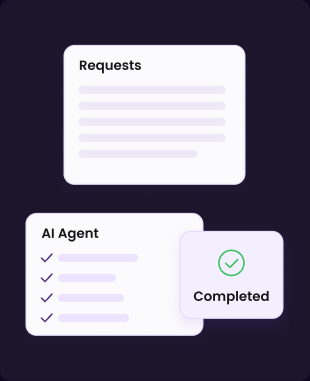
Agents that answer product and service questions, guide buyers and qualify enquiries — grounded in your own content, so replies stay accurate.
02 / KNOWLEDGE WORK
Finding What Your Team Needs
Agents that read contracts, policies and internal documents, then retrieve the right answer in seconds instead of the hours your team spends searching.
03 / DAILY OPERATIONS
Doing The Repetitive Work
Agents connected to the tools you already run your CRM, ERP or helpdesk so records get updated and work moves forward without manual re-entry.
Reliability
Controls Passing
04 / END-TO-END PROCESSES
Running A Whole Process
Multi-agent systems that carry a process from start to finish across several systems, with approvals and human checks built in where decisions matter.
Not sure which type of agent fits your requirement?
Tell us about the business process or problem you want to improve. We'll help assess the work and recommend the right agent approach before development begins.
A useful agent needs more than intelligence alone. It needs the right context to understand what matters, access to the right information at the right time, and clear boundaries that define what it can do, what it should avoid, and where human judgment is still required.
We bring all of these pieces together around your specific requirements, workflows, and priorities — so the agent can work naturally within your business.
Context Engineering
We define the instructions, business context, goals, constraints, and information required to guide agent behaviour.
Knowledge & RAG
We design retrieval systems that give agents access to relevant documents, data, and business knowledge.
Tools & Integrations
We connect agents with APIs, databases, applications, and approved business systems.
Control & Oversight
We design permissions, guardrails, escalation paths, and human checkpoints where required.
Start With One Requirement
Have a process in mind? Let’s figure out what to build.
Pick one workflow taking too much time. We'll help you assess it and decide what is worth automating.
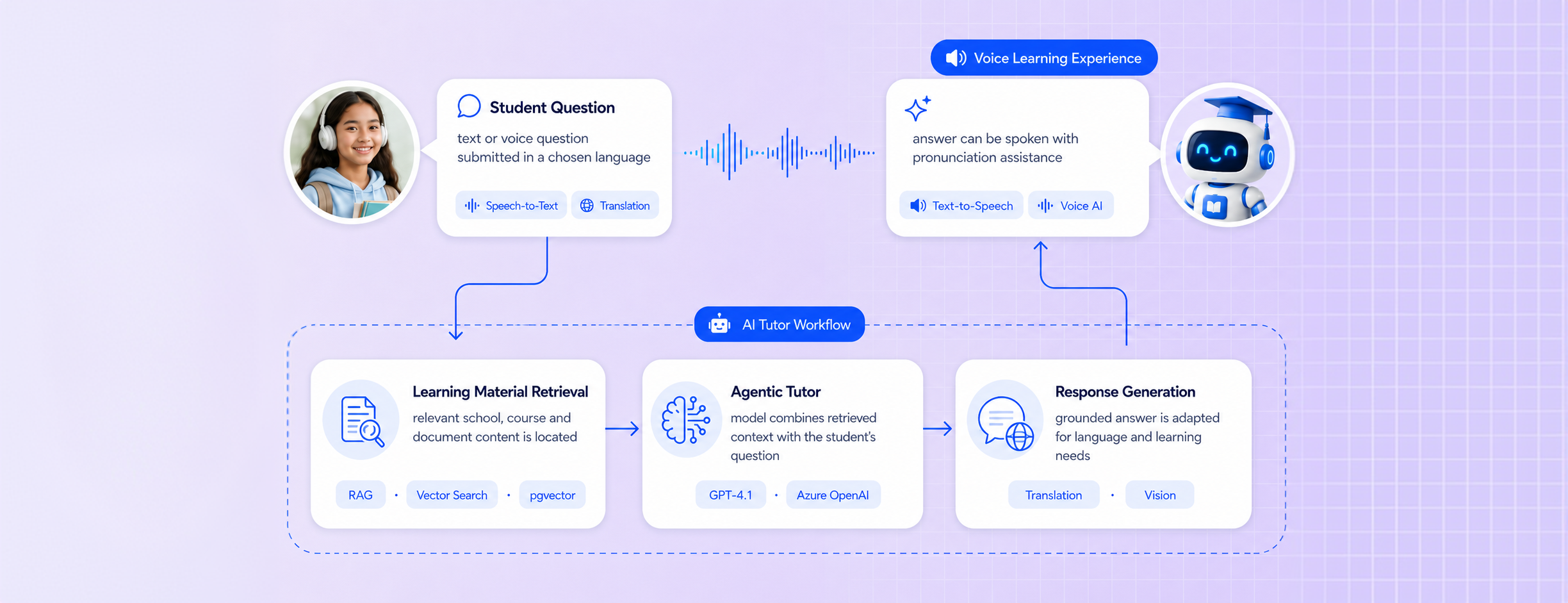
Agentic Learning Platform for Grounded Student Support
For schools and education providers, this agentic tutoring platform answers student questions from specific course, school and document materials rather than general model knowledge.
Impact
2x
More accessible student support
Grounded Across School, Course And Documents
Multilingual Text And Voice Support
GPT-4.1 With Retrieval-Augmented Generation
Speech, Translation And Visual Understanding
AI Voice Agent
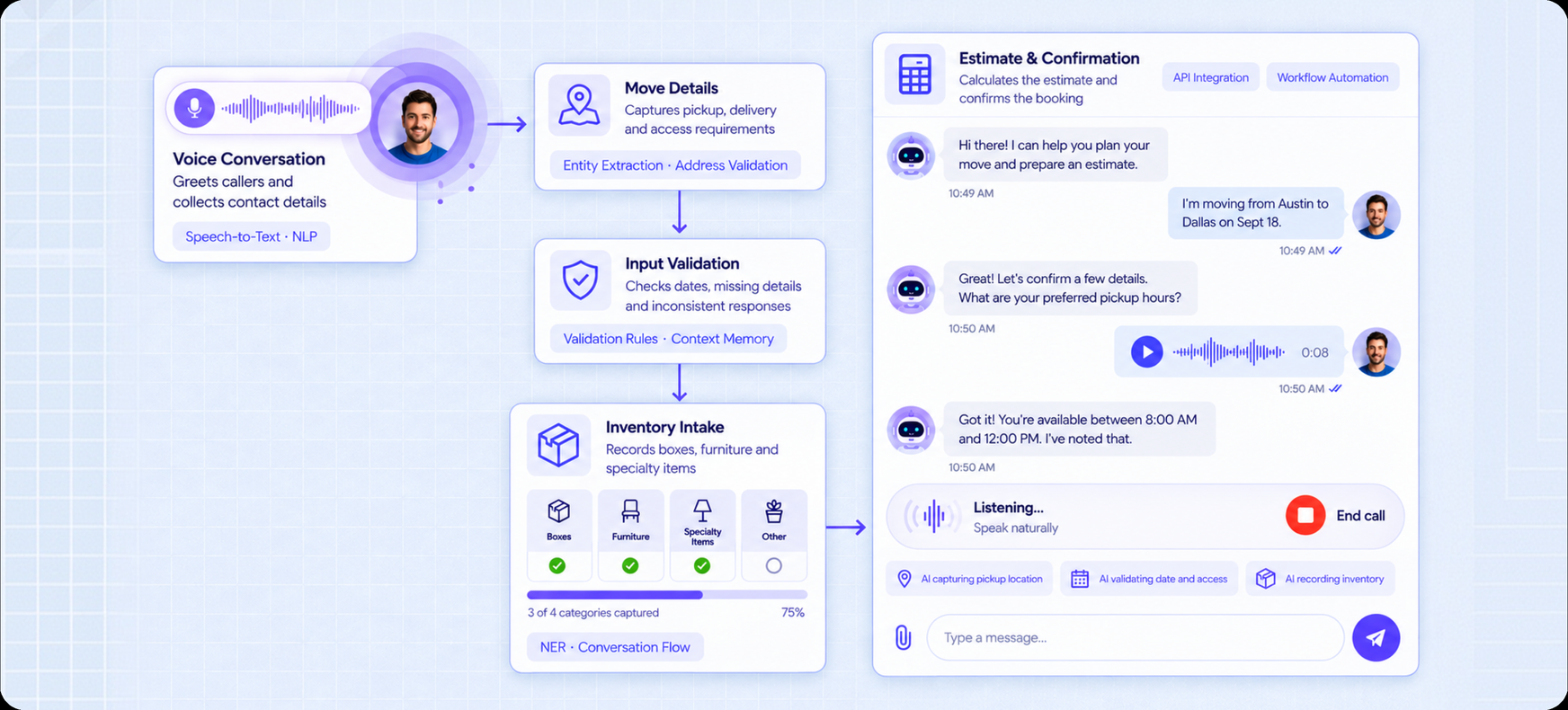
AI Voice Agent for Moving Estimates
For a residential moving company, we built an AI voice agent that handles inbound requests from first contact through inventory collection, validation, estimate calculation and booking confirmation.
Impact
60%
Reduction in manual coordination
Captures 15+ Inventory Items
Handles Multi-Step Move Details
Validates Dates And Addresses
Routes Off-Topic Requests Safely
Agentic AI Consultant
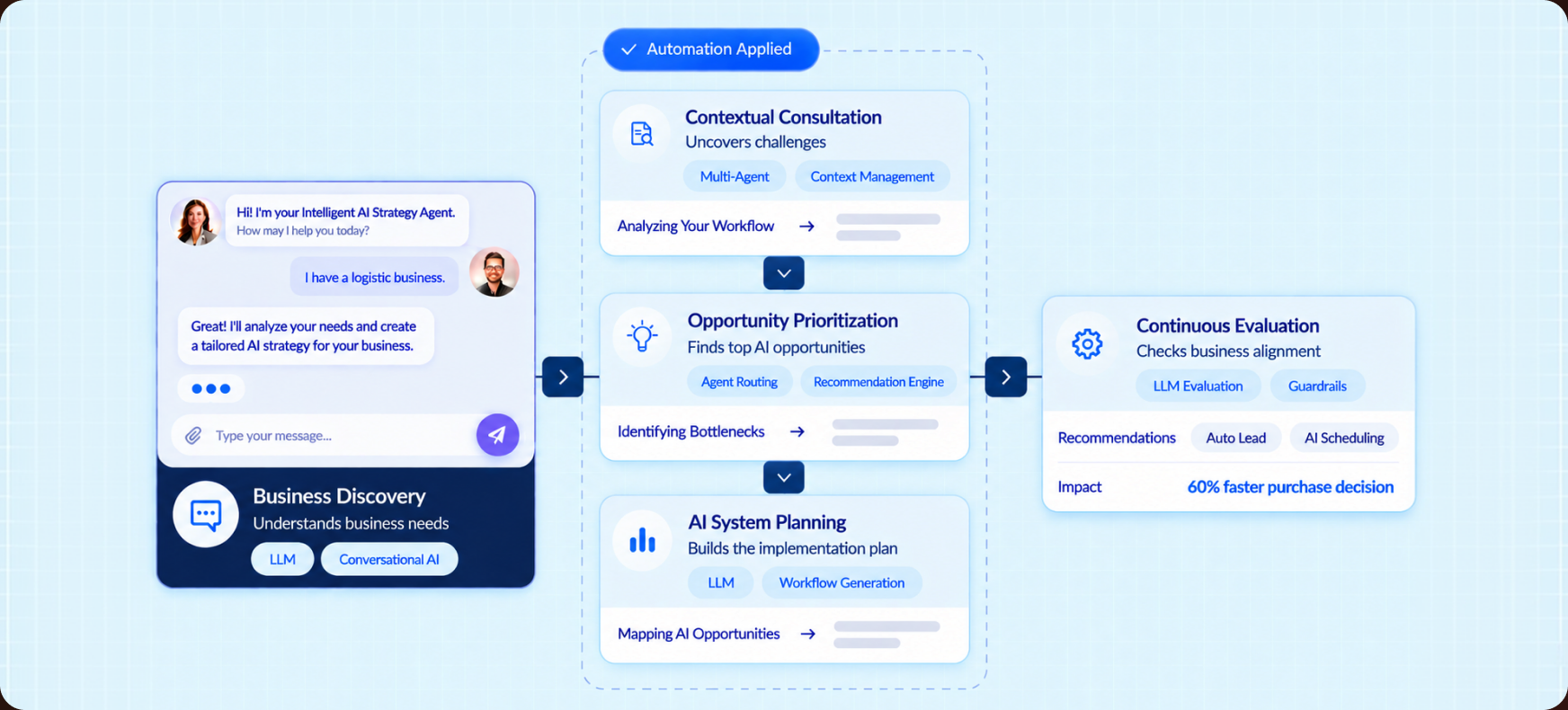
Jovian — Agentic AI Consultant
For an AI consulting business, we designed and developed an agentic platform that guides organisations from business discovery through AI opportunity prioritisation and implementation planning.
Impact
60%
Faster AI opportunity discovery
LangGraph-Based Multi-Agent Architecture
Contextual Business Discovery Conversations
Dynamic AI Workflow Recommendations
Continuous LLM Recommendation Evaluation
Conversational AI Assistant
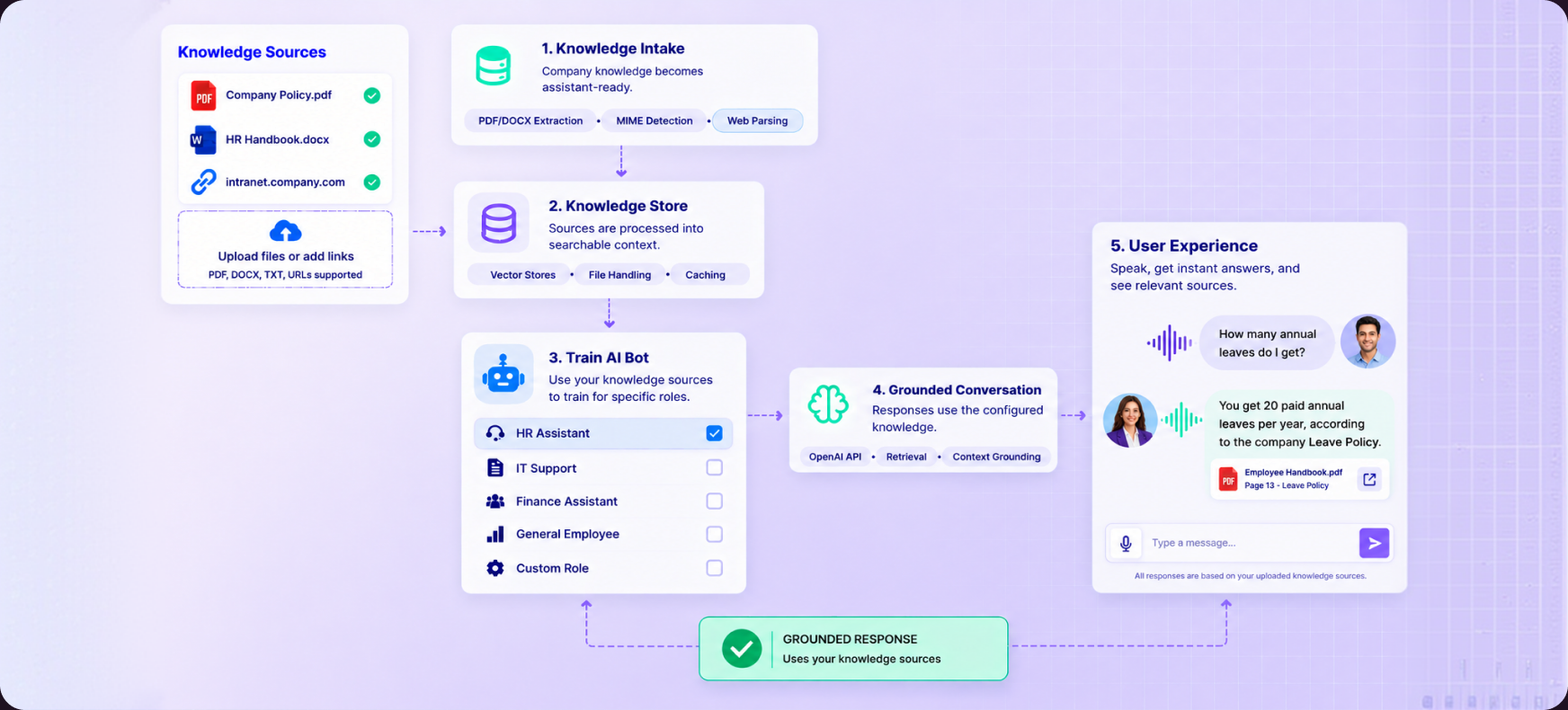
Conversational AI Platform for Owned, Grounded Assistants
For a conversational media platform, we designed and delivered a replacement AI assistant that moved a core capability off an incumbent third-party service and onto the OpenAI API.
Impact
100%
Ownership of AI capability
120+ Active Platform Users
Multi-Source Knowledge Grounding
10+ Year Engineering Relationship
Replaced Incumbent Third-Party Assistant
Why TBI
As an Agentic AI partner
TBI brings deep engineering experience to practical AI implementation. We help businesses identify where AI fits, design the right approach, and build agents around the workflows, knowledge, systems, and controls they already have.
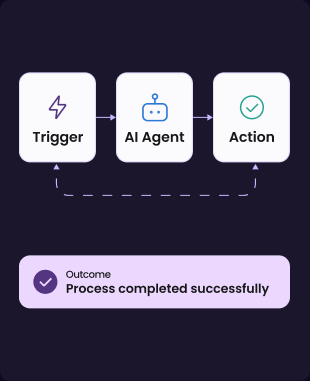
Our engineers design agents around how the work needs to move: set the goal → retrieve context → reason and decide → choose a tool and take action → involve human approval or follow an alternate path → evaluate the outcome. This helps us build AI agents designed for real business use not just demonstrations.
15+
Years building production software
5.0 ★★★★★
Client reviews on
100+
Systems built across web, business, and digital products
From agent idea to a solution your team can rely on.
Agent Evals
We define expected outcomes and test whether the agents we build consistently perform as intended across relevant scenarios.
Tracing & Observability
We implement visibility into workflows, tool calls, retrieval, decisions, and agent execution where appropriate for the architecture.
Guardrails & Reliability
We design boundaries, permissions, fallback behaviour, and failure handling around agent actions.
Model Strategy
We help determine whether the solution should use Claude, OpenAI, another suitable model, or a combination based on the requirement.
Cost & Performance
We consider model usage, retrieval, tool calls, latency, workflow execution, and the operational cost of the agent.
Continuous Improvement
We refine prompts, retrieval, evaluations, workflows, and behaviour using testing and real-world insights.
Frequently asked questions.
Yes. You do not need to provide a complete technical specification. You can start with the task, process, users, systems, and outcome you want to improve. We help you assess the requirement, understand what information and integrations are involved, and recommend the right level of complexity before development begins.
The goal is not to push every idea into a complex custom build. We help define an approach that makes sense for the requirement and gives you a clear starting point.
We look at the task, the systems involved, and the type of decision-making required before recommending an architecture. Some requirements are best served by a simple workflow automation, others need retrieval over your business data, and some require a fully agentic system with tools, memory, and multi-step reasoning.
We match the complexity to the requirement rather than defaulting to the most advanced option, and we walk you through the reasoning so the recommendation is clear.
Yes. Not every requirement needs a custom-built agent from scratch. In many cases, configuring an existing platform such as Claude, along with the right prompts, tools, and guardrails, can meet the requirement faster and at lower cost. We assess whether an existing platform can be configured to do the job before recommending a custom build, and we are upfront when a custom approach is genuinely necessary.
We recommend LangGraph when a requirement needs explicit control over multi-step reasoning, branching logic, state that persists across steps, or coordination between multiple tools and sub-agents. It is not something we reach for by default. For simpler workflows or single-purpose agents, a lighter-weight approach is usually a better fit.
We choose the framework based on what the architecture actually needs, not on what is trending.
Yes. We can build agents that retrieve answers from your documents, knowledge bases, product data, or internal systems, so responses are grounded in your actual business information rather than general knowledge.
This includes structuring and indexing your content, setting up retrieval, and testing the agent against real questions your team or customers are likely to ask.
We keep communication direct and consistent through regular updates, working sessions, and access to whoever is building your solution rather than routing everything through account management layers. You will know what is being built, why, and what to expect next at each stage of the project.
Yes, where suitable access and integration options are available. We can design agents around APIs, databases, CRMs, internal applications, helpdesks, SaaS platforms, and other approved business systems. We assess the systems involved before deciding how the solution should connect and what permissions the agent should have.
The aim is to add AI around the tools your team already relies on rather than creating unnecessary disruption or requiring a complete rebuild of your existing processes.
We define expected outcomes for the agent and test it against a set of relevant scenarios before it goes live, including edge cases and situations where it should decline to act. This is not a one-time check.
We continue evaluating performance after launch and use real usage data to catch issues and refine behaviour over time.
Yes, where appropriate for the use case. We can build in approval steps, review checkpoints, and escalation paths for actions that carry risk, cost, or need for judgement, so the agent supports your team's decisions rather than operating without oversight.
The right level of human involvement depends on the requirement, and we help determine where that line should sit.
Launch is not the end of the engagement. We monitor how the agent performs in production, track where it succeeds or falls short, and refine prompts, retrieval, and workflows based on real usage. We can also support you as requirements evolve, whether that means expanding the agent's scope, connecting additional systems, or building the next agent for a different part of the business.
A chatbot usually matches a message to a predefined response. Conversational AI goes further: it interprets what someone means, holds context across a conversation, and forms an answer from approved business information. An AI agent adds the ability to act — it can use tools, call your systems, and complete a multi-step task rather than only replying.
Most requirements land somewhere on that scale, and the right answer is rarely the most advanced option. We assess what the interaction actually needs to do before recommending where on that scale your solution should sit.
Yes to both. We build voice agents for situations where speaking is faster or more practical than navigating an interface, designed around the accents, speech patterns, and context in which people will actually use them.
For multilingual work, we build agents that hold a conversation across several languages and accommodate regional variation, so a user can move between supported languages without losing the context of what they were doing. Tone and terminology are adapted per market rather than machine-translated from one script.
Yes. Generative models sit inside most of the agents we build — forming answers, summarising, drafting, and transforming information. We also build generative AI applications that are not agents at all: content and document workflows, product information generation, and internal knowledge tools for text, image, audio, or multimodal output.
That work includes adapting pre-trained models on your own data, tuning outputs for relevance and consistency, and connecting the capability to the review and approval steps your business requires before generated output is used.
Yes, and it is often the sensible route when the open question is whether AI can produce useful results against your data. We build focused proofs of concept to test exactly that, then turn a validated concept into an MVP you can put in front of real users.
We structure a POC as maintainable software rather than a throwaway demo, so a successful experiment has a practical path into production instead of needing to be rebuilt from scratch.
Yes. You do not need to build and operate the full underlying AI infrastructure to use an AI capability. We can connect managed capabilities — language processing, speech, translation, classification, prediction, or content generation — into the applications and workflows you already run, and build the application layer that makes them useful in your business.
That also covers the work around the model: data flow, deployment, integrations, monitoring, and ongoing refinement. It makes it practical to introduce one defined capability first, see how it performs in your operation, and expand only when there is a clear reason to.
It depends on scope, and we price and schedule after understanding what the system needs to do and what already exists around it. As a rough guide, a focused build can run around 9–12 weeks, while a complex production implementation can take six months or more.
Data readiness, integrations, security requirements, and the amount of validation needed before launch move that range more than the AI itself does. Adding one capability to an established application is a very different scope from a new product needing data pipelines, multiple workflows, interfaces, and ongoing evaluation. Share the requirement and we will define the scope before quoting.
15+ Years Of Building Software
Ready to put AI to work?
Start with one requirement. We’ll help you build the right solution.