

 By
By 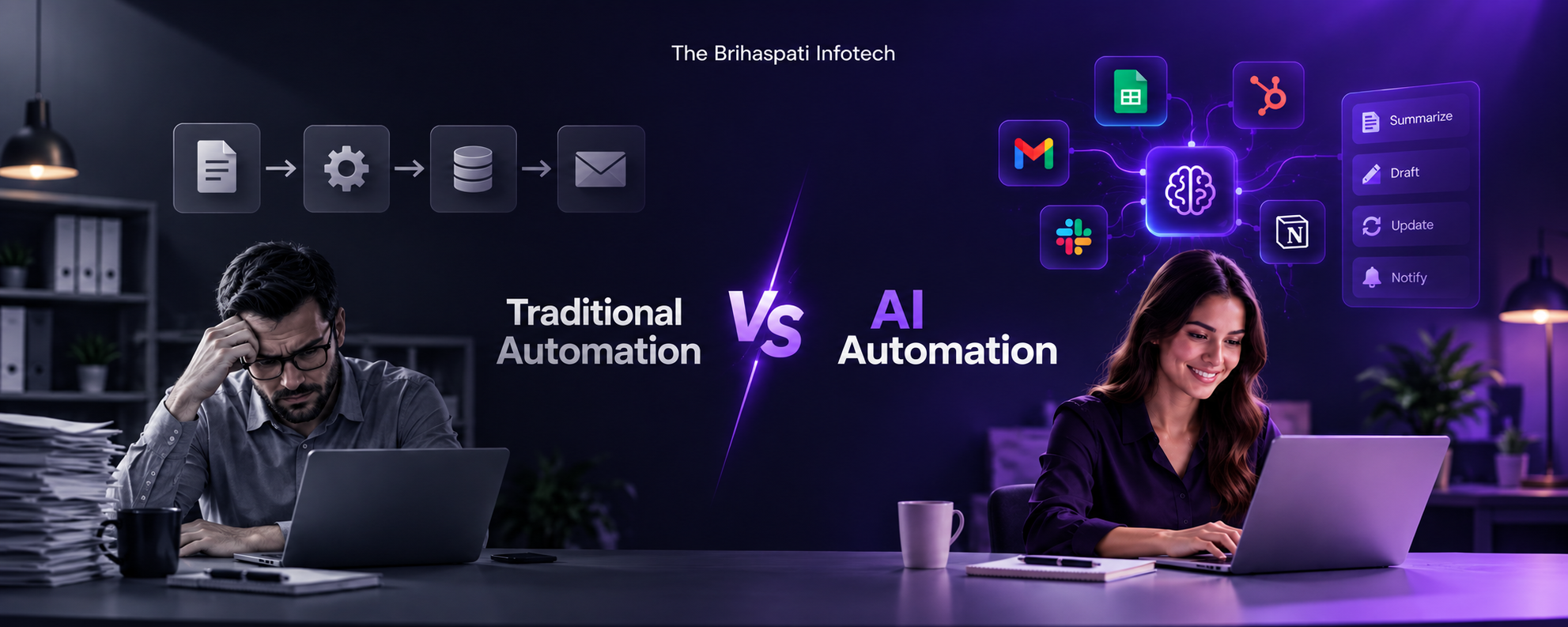
- Traditional automation executes predefined rules: if X happens, do Y. It is fast, reliable and cheap to run.
- Its limitation is exceptions. The moment input doesn’t match the rule, the process stops and waits for a person.
- AI automation adds a decision layer using language models, natural language processing and computer vision.
- That layer reads unstructured input, interprets context, and chooses the next action rather than following a fixed path.
- Well-designed systems escalate complex or high-risk decisions to a human instead of guessing.
- Neither approach is universally better. Rules-based automation remains the correct choice for well-defined, high-volume tasks.
THE MYTH
What is traditional automation, and where does it stop?
Traditional automation involves programmers creating software with a defined set of rules, enabling the software to react in predetermined ways when certain circumstances or conditions arise. This approach allows users to execute tasks consistently and efficiently without requiring human intervention.
A person writes instructions for a computer to execute repeatedly when it meets a specific condition, independent of any additional qualifications. Most companies have multiple rules for automated processes, such as form submissions to databases, invoice approvals for large amounts, and customer notifications for order status changes.
The software independently carries out the task every single time the specified action occurs, instead of executing the rules manually. The automation proceeds at a rapid pace, and can continue indefinitely until it reaches a specified end point. A software automation will always perform the same task in precisely the same way when you enact the same trigger.
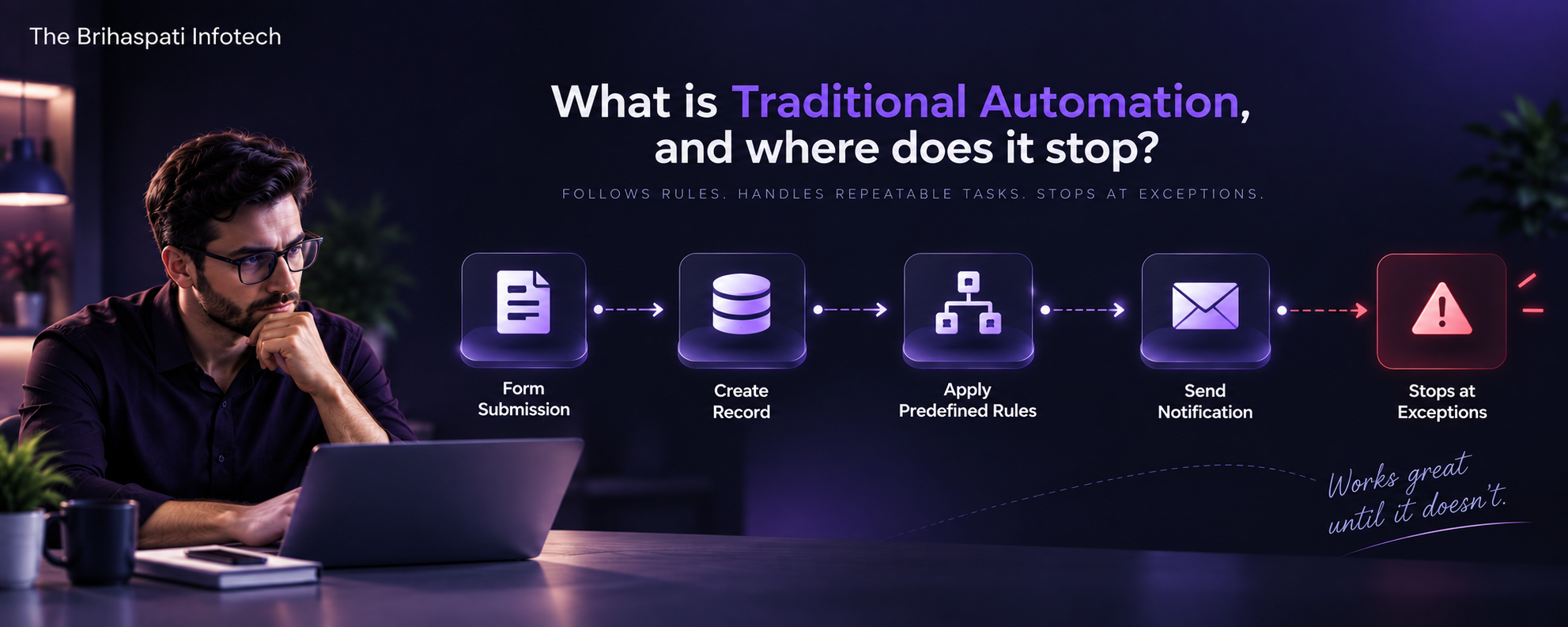
The only limitation is the criteria which the initiating individual programmed into the system. If a supplier replies to the company’s correspondence with a handwritten response, the system will not know how to process the information. An invoice may come in a unique or uncustomized format, preventing the system from recognizing the necessary fields to input.
A customer may ask a question in a manner that was not anticipated, and the system will not have a process to follow which addresses their concern. In all of these examples, the automation process will halt the procedure and require that a person intervene.
THE DIFFERENCE
What does AI automation add?
AI automation keeps the rules and adds a decision layer on top of them.
01
Reads plain language
Understands what someone meant, not just the keywords they used.
02
Extracts data from documents
Pulls details out of emails, PDFs, invoices and scans automatically.
03
Weighs context
Assesses the situation and decides the next best action in real time.
04
Escalates when unsure
Routes complex or high-risk cases to a person instead of guessing.
That layer uses large language models, natural language processing and, where relevant, computer vision to interpret input that rules can’t parse. Rather than matching against a fixed pattern, it reads what arrived, works out what it means, and determines what should happen next.
THE COMPARISON
How do rules and AI differ in practice?
The seven differences below describe what that actually changes.
| # | Question | Traditional | AI-powered |
| 1 | Rules or judgement? | Follows instructions written in advance | Interprets at the moment of execution |
| 2 | Forms or documents? | Needs structured fields | Reads emails, PDFs, scans, photos |
| 3 | Keywords or meaning? | Matches exact strings | Understands intent |
| 4 | What happens at an exception? | Stops and queues for a human | Resolves most of them itself |
| 5 | Fixed path or chosen path? | One predetermined route | Selects the action that fits |
| 6 | Who decides when unsure? | Fails safely, does nothing | Escalates to a person by design |
| 7 | Static or improving? | Unchanged until edited | Sharpens as data accumulates |
DIFFERENCE 1:
Rules versus judgement
Traditional automation follows instructions written in advance by a person who had to think of everything.
AI automation uses interpretation at the point of execution – and can deal with input the designer never specifically considered, because it is reasoning about the content, rather than matching it against a list.
This flexibility is also a danger, which is why the escalation behaviour in Difference 6 is so vital.
DIFFERENCE 2:
Structured versus unstructured input
Rules-based systems require structured data, a form field, a particular column in a database table, or a specific response in an API request. Throw a PDF at them, and they have no idea what to do.
An AI system works on unstructured input, text emails, PDFs, invoices, contracts, scanned documents, and photos. NLP powers text, while computer vision expends to photos and scans.
This ability alone accomplishes most of the work previously done by rules-based systems because most information that needs automating comes in the form of a document or a message rather than a form.
DIFFERENCE 3:
Keywords versus meaning
A rules-based system searching for “delivery date” finds “delivery date.” It’ll miss “we’ll have these with you thursday.”
Therefore Language models understand meaning, they don’t match strings. A supplier writes, “running behind on the white roses, should be with you Monday instead,” and understands that a particular line item has been delayed without any explicit instruction of the phrase “delivery date” or even the word “delivery.”
DIFFERENCE 4:
What happens at an exception
This is the most significant difference in terms of day-to-day operations.
Moreover, the process that uses traditional automation stops processing at an exception and sends that particular item to a person for handling. Essentially, the person handling the queue is the weakest link in the chain, and the automation was supposed to help eliminate them.
Meanwhile, AI automation processes many of these exceptions on its own by understanding the context in which it is working. The queue still exists but only contains particularly complicated cases.
DIFFERENCE 5:
Fixed path versus next best action
Rules-based workflows follow a linear progression. Step one is followed by step two and then three.
An AI layer can examine the context and decide what should happen next, trigger a certain workflow, update a CRM record, draft and send a response, generate a report or send the item to a specific team. Therefore, the path is selected at execution-time according to the needs of the situation.
DIFFERENCE 6:
How each handles the unknown
A rules based system which encounters something beyond its design either fails obviously or not at all. Both are safe in their own way, for the system will not attempt to make up an answer.
An AI system attempting an unfamiliar task is a genuine possibility which has a genuine risk. A well-designed system will therefore incorporate explicit escalation points, and it will delegate decisions that are too complex, ambiguous, or risky to a person who can make a call on them rather than allowing the computer to make a decision automatically.
Designers should deliberately incorporate the human-in-the-loop principle into any responsible system. The Brihaspati Infotech builds every system this way, automate the preparation, keep the consequential decision with the person accountable for it.
DIFFERENCE 7:
Static versus improving
A rule is exactly what it was yesterday until somebody changes it.
An AI powered workflow can improve with experience, by gaining better recall from an expanding knowledge base, improved prompting, or retraining based on observed results. This is not an inherent capability and does not happen by accident, but it is possible, by logging predictions and reconciling them with actual results.
THE HONEST PART
When is traditional automation still the better choice?
Often. AI automation is not an upgrade to be applied everywhere.

Inputs are consistent
Nothing to interpret, so nothing to gain

Volume is high
A rule costs a fraction of a model call, every run.

Auditability is required
Deterministic logic can be read line by line.
Regulation applies
“The model decided” satisfies no regulator.

Latency matters
Milliseconds versus seconds..
Adding a language model to a task that already suits a rule-based approach makes it slower, more expensive, and less understandable. Eventually, this is a downgrade masquerading as an upgrade.
The pragmatic solution is a hybrid. In general, it involves using rules to define the deterministic core of a process, and using the AI layer to interpret the document, understand the message, and manage the exception. Most production systems heavily drive rules and employ intelligence at points where rules prove insufficient.
IN PRACTICE
What does this look like in a real business?
A recent procurement build is a good example.
A florist’s purchasing ran on spreadsheets and manual cross-referencing. In details, inventory was in one place, event schedules in another, purchase history in a third, and supplier conversations in an inbox. Traditional automation couldn’t fix it, because the hard parts of the process were interpretation problems, not routing problems.
So, The Brihaspati Infotech built an intelligent workflow in n8n that combines both approaches.
01
Rules handle the routine
Pulling data from each source on schedule, creating purchase orders, updating records.
02
ML handles the judgement
Weighing trends, stock, forecasts and supplier data to propose what to buy and when.
03
NLP handles the inbox
Reading free-text supplier replies and updating delivery timelines automatically
04
The owner still decides
Every recommendation goes for approval before anything is ordered.
Rules perform the deterministic elements of the task, such as pulling data from each system on a set schedule, generating purchase orders after approval, and record updates. The machine learning recommendation engine takes care of the judgement elements, analysing trends, stock levels, demand forecasts and supplier info to recommend what, how much and when to order.
Then, a second process pulls the reply from the supplier email, which is unstructured text, written by people, in no particular format, extracts the purchase order information and updates delivery schedules without any humans watching over the inbox. This is where traditional automation falls short.
To enumerate, the recommendation is never executed without first going through to the owner for approval. The system prepares the decision, the owner makes it.
THE TAKEAWAY
What this means for your business
The key question is, where do rules currently end in AI automation processes? This is clear where tasks shift to individuals, such as reading emails, entering data, or managing exceptions. That’s where decision-making occurs.
At every other point, a rule is probably a better bet. Pinning down that exact point is usually the hard work, as well as laying out the decision layer properly around it. That’s precisely what The Brihaspati Infotech specializes in. It doesn’t give you a generic AI tool and tell you to figure out for yourself where interpretation is truly required. The Brihaspati Infotech does the mapping work and builds the layer accordingly.
In short, AI automation is not a replacement for people, and it is not a replacement for the automation you’ve already got. It adds interpretation at the points where a process currently ends and waits on a human to provide it, which is the hardest work The Brihaspati Infotech has taken off your plate.
Determining the appropriate role of AI automation in a business requires tailored insights rather than a generic approach. The Brihaspati Infotech, with over fifteen years of software experience and a dedicated AI practice, offers a free AI Automation Consultation to identify valuable automation opportunities without pressure or generic pitches.
Disclaimer: References to third-party products or companies are informational and do not imply affiliation, association, endorsement or partnership.