
 By
By 
- Peak event season meant late nights across several spreadsheets, and stock shortages happened anyway.
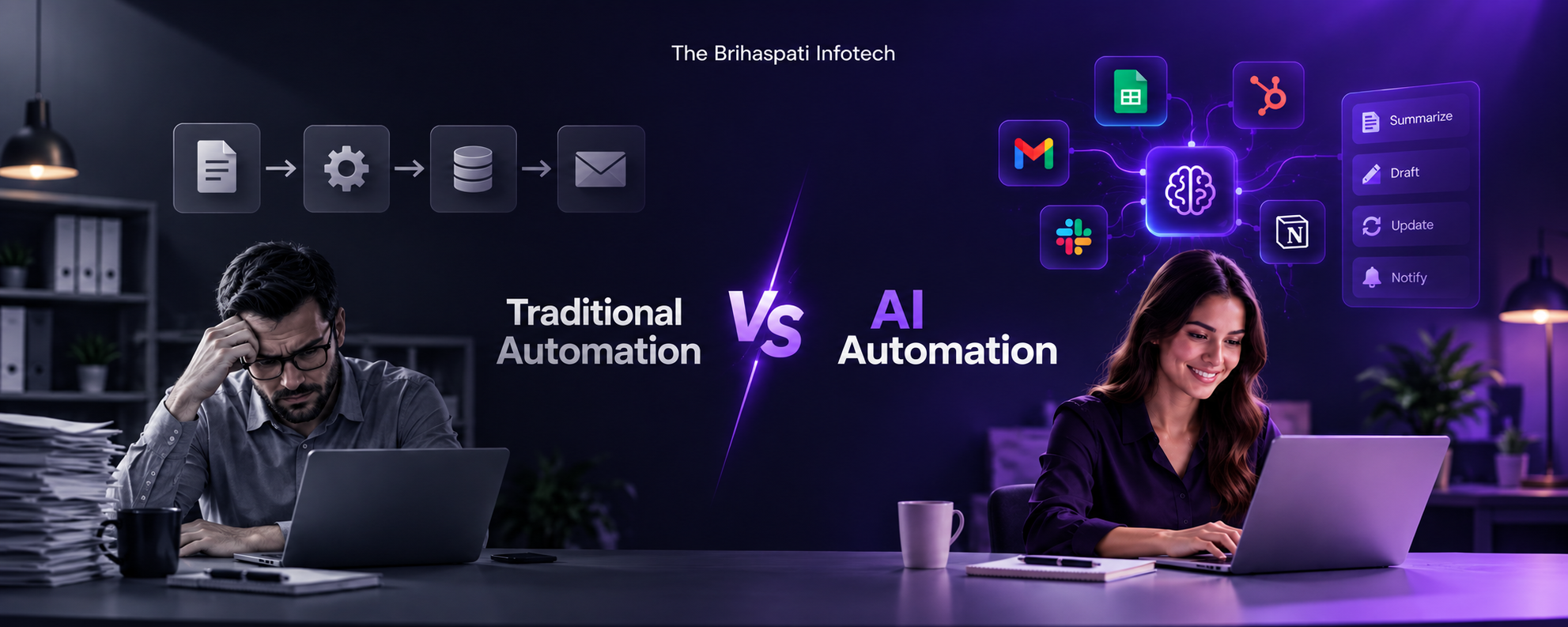
- The Brihaspati Infotech built an intelligent procurement workflow in n8n rather than adding another software subscription.
- An ML recommendation engine reads inventory, event schedules, purchase history and supplier data to answer three questions: what to order, how much, and when.
- Nothing is purchased without the owner’s approval. The system prepares the decision, the owner makes it.
- A second workflow monitors supplier replies, extracts the details and updates delivery timelines automatically.
- The outcome: fewer shortages, less overstocking, faster decisions, and hours returned to the business.
THE PROBLEM
What does procurement really look like in a small business?
For this florist, every busy event season followed the same script. Late in the evening, someone would count stock, then open one spreadsheet for current inventory, another for the coming month’s events, and a third for what had been ordered the previous year. Reconciling those three by hand was the only way to work out what needed buying.
Then came the supplier calls and emails, the purchase orders typed one at a time, and the follow-ups chasing confirmations that hadn’t arrived. Hours of skilled attention every week, spent on work no customer would ever see.
What made it genuinely frustrating was that the effort didn’t solve the problem. The business still ran short during peak weeks, still waited on late supplier confirmations, and still found itself making rushed purchasing decisions with a large event days away.
This is worth pausing on, because “procurement automation” gets used loosely. It doesn’t mean handing buying decisions to software, and it doesn’t mean bolting on another dashboard. As The Brihaspati Infotech frames it, procurement automation means connecting the data a business already has, inventory, bookings, history, supplier replies, so the person buying doesn’t have to reassemble that picture by hand every single time.
The florist’s problem was never a lack of software. It was that nothing was talking to anything else.
THE DIAGNOSIS
Why do spreadsheets break exactly when you need them most?
The business wasn’t badly run. The owner knew the trade, knew the suppliers, and had a good instinct for what each season would demand. That instinct was the only reason the manual process worked as well as it did.
The failure was structural rather than personal: procurement depended on manual decisions feeding disconnected processes.
Inventory lived in one system. Event schedules lived in another. Purchase history sat in a spreadsheet, and supplier conversations sat in an inbox. Because none of those sources spoke to each other, a person had to assemble the complete picture in their head and rebuild it from scratch every time a buying decision came up.
That approach holds up at low volume. It degrades quickly as a business grows, because the cost of reassembling the picture rises while the hours available to do it stay fixed. Peak season is exactly when the process matters most and copes least.
The pattern turns up across industries, even though the symptoms look different. A restaurant runs out of a key ingredient on its busiest night. A workshop discovers mid-job that a part isn’t in stock. A retailer is left holding inventory that stopped selling three weeks earlier. In each case the underlying fault is the same one.
THE APPROACH
Why not simply buy procurement software?
The straightforward recommendation would have been a procurement platform. The Brihaspati Infotech advised against it, because the florist didn’t have a software gap. They had a connection gap.
Introducing a procurement platform would have meant adding a tenth system to a business already struggling to reconcile nine, along with a monthly subscription, a migration, staff training, and a set of built-in assumptions about how a florist ought to operate. Those assumptions may or may not have matched how this particular florist actually works.
The team built an intelligent workflow instead, using n8n an automation platform designed to connect existing systems rather than replace them. The business’s data stayed where it already lived. The workflow simply learned to read all of it at once, which is precisely what a person had been doing manually at the end of each day.
THE BUILD
How does the workflow operate?
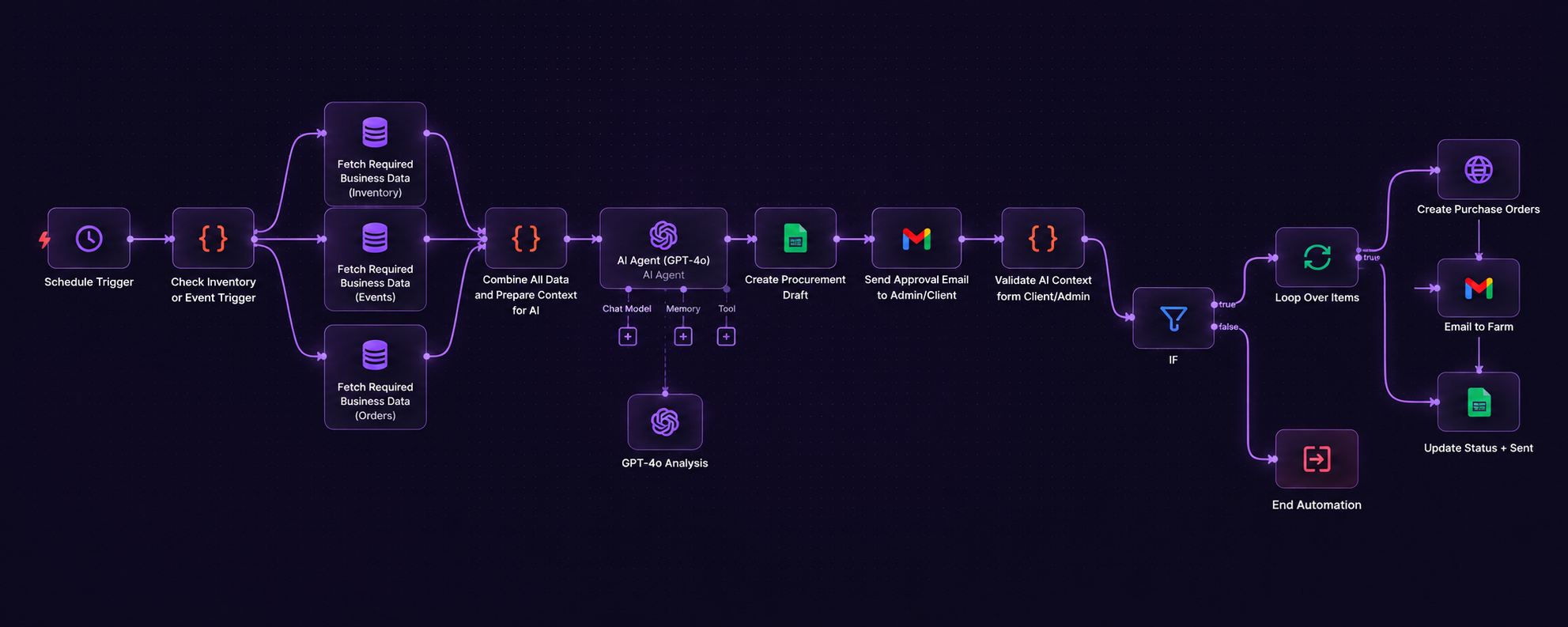
The system runs in four stages.

Assembling the picture.

Generating a recommendation

Routing to a human
Executing
Assembling the picture. The workflow gathers current inventory levels, upcoming event schedules, historical purchase data and supplier information into a single view. This is the step that previously required a person and several spreadsheets, and it now runs without anyone involved.
Generating a recommendation. With full context in place, an ML-powered recommendation engine analyses historical trends, current stock positions, demand forecasts and supplier data to answer the three questions procurement turns on: what to order, how much to order, and when to order it.
Those last two deserve attention, because most inventory tools only answer the first. Quantity and timing are where the money actually leaks. Order too much and cash sits in a cold room losing value by the day. Order too late and a large event goes short.
Routing to a human. The recommendation goes to the owner for approval, and nothing is purchased before that happens.
Executing. Once approved, the workflow creates the purchase orders, sends them to the relevant suppliers, and updates the procurement records. Nothing is retyped and nothing is forgotten.
THE CONTROL
Why does a human still approve every order?
Because the owner knows things the data doesn’t.
A model can see that the same week last year consumed 400 stems of a particular variety. It has no way of knowing that one unusual event drove that figure, that a supplier has been unreliable recently, or that a different arrangement was agreed on the phone yesterday.
The system was therefore built as decision support rather than decision authority. It handles the slow, repetitive, error-prone work of assembling context and proposing an answer. The owner supplies the judgement, which is the part that was always genuinely theirs.
This split runs through everything The Brihaspati Infotech builds: automate the preparation, and keep the decision with the person accountable for the outcome.
There’s a practical argument for it as well as a principled one. A business owner asked to hand over purchasing control will resist, and reasonably so. An owner handed a prepared recommendation and a clear approve-or-adjust choice will use the system from the first week. Adoption tends to be a question of trust rather than technology.
THE SECOND WORKFLOW
What happens once the order goes out?
This is the stage most automation projects leave alone, and it hides a surprising volume of manual work.
Sending a purchase order is the easy part. Tracking what follows is the grind: watching for supplier replies, noting confirmed quantities, recording delivery dates, and remembering who hasn’t responded.
A second workflow takes care of it. The system monitors supplier emails, extracts the relevant purchase order details, updates delivery timelines and notifies the owner directly. Nobody scrolls an inbox looking for confirmations, and nobody transfers a delivery date into a spreadsheet by hand.
The owner learns what’s happening because the system tells them, rather than because they went looking.
THE OUTCOME
What changed for the business?
Operationally, the business saw fewer stock shortages, less overstocking, faster procurement decisions and better supplier coordination, with complete visibility across the procurement process at any moment rather than a picture reconstructed on demand.
For the owner personally, the late evenings stopped, and the hours that used to go into cross-referencing spreadsheets went back into running the business.
One point of honesty is worth making here. This engagement didn’t produce a headline percentage, and inventing one would be easy and dishonest. The improvements are real and the owner can describe them, but they haven’t been measured against a controlled baseline, largely because the previous process generated no reliable data to measure against, which was part of the problem being solved. Any agency quoting a precise improvement figure for a project of this kind is estimating rather than reporting.
THE PATTERN
Does this only work for florists?
Very little about the solution is specific to flowers.
Remove the industry and the pattern reads, a business holding perishable or variable-demand stock, buying from several suppliers, forecasting from experience rather than data, and coordinating the whole process over email.
That describes a great many operations:
1.
Restaurants and catering — ingredients ordered against a booking calendar
2.
Salons and clinics — consumables against an appointment book
3.
Retail and ecommerce — reordering against sales velocity and seasonality
4.
Workshops and trades — materials against a job schedule
5.
Manufacturers — components against a production plan
6.
Event and hire businesses — stock against a booking pipeline
As a rough test, if three of the following are true, the same approach usually applies:
01
Someone checks stock manually and compares it against what’s coming up
02
Buying decisions rely on experience rather than data
03
Purchase orders are typed out by hand
04
Someone chases suppliers for confirmations
05
Delivery dates live in an inbox rather than a system
06
The business still gets caught short during busy periods
The data sources change from business to business. The structure of the problem doesn’t.
THE TEAM
Who built it?
The Brihaspati Infotech has been building software for clients for more than fifteen years, with a dedicated AI practice of eight delivery engineers supported by an organisation of 75 to 80 people working under a company-wide AI certification mandate. AI capability sits across the team rather than in a specialist corner of it.
That practice covers four areas, all of which share the same design philosophy:
01
Machine learning prediction.
A pricing engine built for a moving company, trained on 38,840 completed jobs across 744 features, producing quotes in under a second with a guardrail layer that routes unusual jobs to human review.
02
Computer vision.
A 70-class material classification system that has handled 190,000 classification events, architected so that trusted data is checked first and model inference acts as the fallback.
03
Agentic AI.
A multi-stage LangGraph agent running in production across 1,433 conversation threads, with PII redaction, model tiering and prompt-injection evaluation built into the pipeline.
04
Retrieval and workflow automation.
Assistants grounded in a client’s own documents and data, and intelligent workflows of the kind described in this case study.
Different technologies, one consistent method: automate the preparation, and keep the decision with the person accountable for it. That consistency is a large part of why these systems stay in use rather than being quietly abandoned a few months after launch.
THE TAKEAWAY
What this says about automation more broadly
There’s a version of AI automation that promises to run the business on your behalf. It sells well and delivers poorly, because owners won’t hand decisions they’re accountable for to a system they can’t interrogate — and arguably they shouldn’t.
The version that works is narrower and considerably more useful. Identify the repetitive work sitting on either side of a decision: the gathering that happens beforehand, and the executing and chasing that happen afterwards. Automate both ends thoroughly, and leave the decision itself where it belongs.
That’s what happened here. The owner still decides what to buy. They simply no longer spend evenings working out what the options are, or mornings chasing suppliers who haven’t replied.
If purchasing, quoting or supplier coordination is still costing you evenings and creating shortages, book a free AI Automation Consultation with The Brihaspati Infotech today. We’ll map exactly where the manual work is hiding in your business and show you what an automated version looks like — no obligation, no generic pitch, just a clear plan built around how you actually operate.
Disclaimer: References to third-party products or companies are informational and do not imply affiliation, association, endorsement or partnership.