

 By
By 
- AI does not rank page. ChatGPT does not rank pages by comparing them to one another. Moreover, it analyzes what information a business has published in relation to what the client asked for.
- Three examples have been tested. The Brihaspati Infotech put three different customer inquiries in the chatbot: retail, product-specific shopping and local B2B services.
- Specific information is easier to match for AI. Having specifics on the services offered, locations, capabilities, availability, prices, and policies offer more relevant signals than generic terms such as “innovative end-to-end solutions.
- 88% of companies were never shown in results in one 2026 study of 1,700 businesses.
- Conflicting information hurts. If a business lists different prices, service areas, hours of operation, or other information on different platforms, the AI may have difficulty distinguishing between them.
THE CONTEXT
Ranking first on Google doesn’t necessarily mean that AI will recommend you.
AI considers relevance, reliability, and content quality. Considerably, it is possible that you might rank well on Google, while being ignored by an AI assistant.
For instance, suppose the customer logs into ChatGPT and asks for
“Commercial moving services nearby that have heavy lifting equipment, operate on weekends, and offer insurance.”
In general, users can get one or two suggestions rather than a list of search results. But why does AI recommend specific businesses while search engines ignore them? Despite a company who rank high in Google , can be ignored by artificial intelligence. For the purpose of this distinction is what The Brihaspati Infotech wanted to investigate.
THE EXPERIMENT
Three customers. Three requests.
Eventually now every inquiry had its own criteria.
01
Retail fulfillment
A parent shopping for children’s clothing, who wants quick delivery, clear return policy and hassle-free returns.
02
Product specifc shopping
A student who wants to buy a specific book, in a particular condition and price range.
03
Local B2B services
A facility manager looking for a local moving company with experience in heavy lifting, commercial inventory and liability insurance.
For this reason, the question was never which brand names were involved. In fact he question was which specifications made a business the best option.
WHAT CHATGPT RETURNED
The answer, in full
Frequently, throughout the three situations, indeed the ChatGPT was able to match the options to what the customer was looking, by taking into consideration various aspects like products, price, delivery, return policy, location, rating, and special requirements for a specific choice.
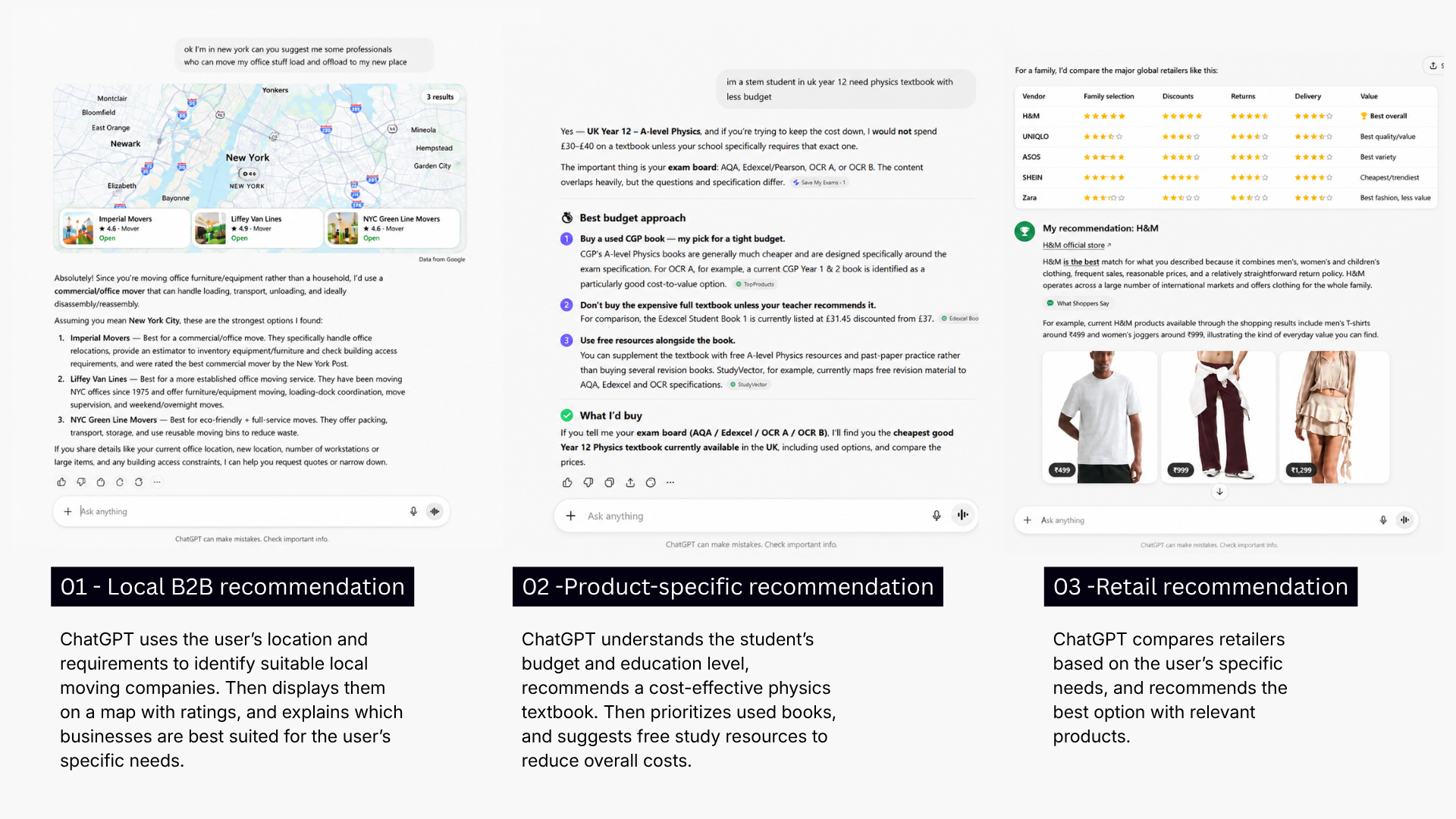
So , ChatGPT doesn’t just search, it evaluates options. It understands context, and makes recommendations on the user’s behalf.
WHAT AI LOOKS FOR
How ChatGPT Identifies Customer Needs Behind a Prompt
Previously in our Local B2B services example customer made query for local moving company with multiple needs. In effect here’s what chatgpt identified those needs in categories:
- Service: Commercial Moving
- Location: Within 50 miles
- Capability : Heavy Machinery
- Scheduling : Weekend Availability
Altogether, chatgpt use these catgories to compare how two companies describe their services. In short, the AI recommendations may vary depending on the systems and locations, but it is important that specific details better matched by AI than general statements. Given below:
Company A
We deliver commerical moving solutions tailored to your unique needs
Company B
We provide commercial moving services within the range of 50 miles, including heavy machinery relocating.
THE VISIBILITY GAP
How wide the gap is right now.
Numbers below explains the AI visibility gap that says a lot about the current market.
88% –
Never mentioned in ChatGPT’s recommendations in the scenarios tested
1700 –
Businesses analysed
32 –
Industries covered
2.5x –
More likely to visit a brand’s site within seven days after being recommended
Meanwhile, a 2026 study performed by Omni Eclipse revealed that 88% of the 1,700 companies surveyed had not been recommended by ChatGPT, while Similarweb reported users were 2.5X more likely to visit a brand that appeared in the results.
HOW IT WORKS
How AI picks a business, step by step.
01
It reads the request
The system pulls out the requirements like service type, location, capability, timing, budget.
02
It collects data
It searches websites, business directories, reviews, product listings and other public sources.
03
It matches and compares
Each detail is checked against requirements. More specific information means more matches.
04
It answers
It names the businesses and usually explains why they qualify.
As a result, the question is no longer, will AI find our site, rather , does AI understand our business well enough to recommend it?
DATA DRIFT
When information conflicts.
Furthermore, your business public information may vary depending upon the sources. Hence, it may be challenging for an individual or a company to ensure that the information is accurate and updated. For example:

Your Official Website
listed price $5,000

Your Youtube
video description says $6000

Your Social Media
says: $4,000

Your Google Business Profile
lists a different service area
In conclusion, The Brihaspati Infotech helps in identifying such inconsistencies across different platforms and ensures that your company’s information is reliable and updated.
THE FIXES
Nine Things To Fix On Your Site
Additionally you don’t need to redesign. Rather start with the information your customers are already asking for, and make sure search engines and AI systems can find and read it.
01
Specific what services you are providing (AEO)
- Say clearly: what you give, who it’s for, where you operate, what’s part of it, what’s not, and what sets it apart.
- Here is where Answer Engine Optimisation fits, arrange your content around the questions people really ask, and respond to them.
02
Put the Most Requested Info at a Glance
- Pricing and pricing structure, service locations, delivery time, product specifications, policies, availability, contact information, FAQs.
- Organize information using headings, short paragraphs and lists for the convenience of both visitors and search engines.
03
Apply Schema Markup for Anything Possible
- Schema markup gives search engines extra data about your site’scontent.
- Useful schematypes are listed in Google’s supported markup gallery,like Organization, LocalBusiness, Product, Service etc.
- Google suggests schemas like name, address, telephone, URL, and logo for Organization markup, with the vocabulary at schema.org.
04
Make your site visible to AI
- Ensure robots.txt doesn’t accidentally block important pages.
- Update your XML sitemap so all desired URLs get discovered.
- Depending on your situation, newer options like llms.txt, a markdown file at your site root listing key pages for AI, might also help.
05
Make your content easy to extract
- Don’t hide important info in images, complex layouts, or interactive media.
- Use headings, clear titles, short sentences, lists, tables, direct answers, and text descriptions of products and services.
- If key details are buried deep behind marketing content, you create extra work for customers and AI.
06
Build for GEO as well as SEO
- SEO: will your page appear in search? GEO: can an AI understand your business enough to mention it in an answer?
- That means moving beyond keywords, services, expertise, locations, policies, products, ratings.
- GEO doesn’t replace SEO. Technical basics still count.
07
Strengthen your entity signals
- Comparatively make it obvious that the information on different sites refers to the same company.
- Keep the business name, website URL, address, phone number, services, locations and organisation details consistent, and use Organization, LocalBusiness, Product or Service schema where relevant
08
Keep your information consistent everywhere
- Your website shouldn’t tell a different story from the rest of the web.
- Check your Google Business Profile, business directories, review sites, social profiles, product listings and industry directories ,especially pricing, services, hours, locations, policies and service areas.
09
Test what AI actually says about you
- Additionly schema and fixing a sitemap isn’t enough.
- Ask the questions your customers would ask, such as “Who offers [service] in [location]?” or “Best solution for [need]?”
- Then check whether your business appears and whether the description accurately reflects what you offer. If not, identify what’s missing, unclear, inaccessible, inconsistent, or unsupported, fix it, and test again..
THE TAKEAWAY
Is Your Website Enough for AI?
Even though your website alone often isn’t enough to establish a strong online presence. AI tools analyze and pull information from your wider digital footprint, not just your homepage. On the contrary this broader examination helps ensure that all aspects of your business are accurately represented across various platforms.
Ultimately, The Brihaspati Infotech developed a free audit tool that checks your website for AI readiness. While it flags missing business details, service descriptions that are too vague to match a search, and contradictions found across different sources. In addtion, it also identifies gaps and highlights areas where AI might describe your business incorrectly, allowing for more effective digital management.
So the goal isn’t to make your website look AI-friendly. In a word it’s to make your business understandable to people and machines alike.
Disclaimer: References to third-party products or companies are informational and do not imply affiliation, association, endorsement or partnership.