
 By
By 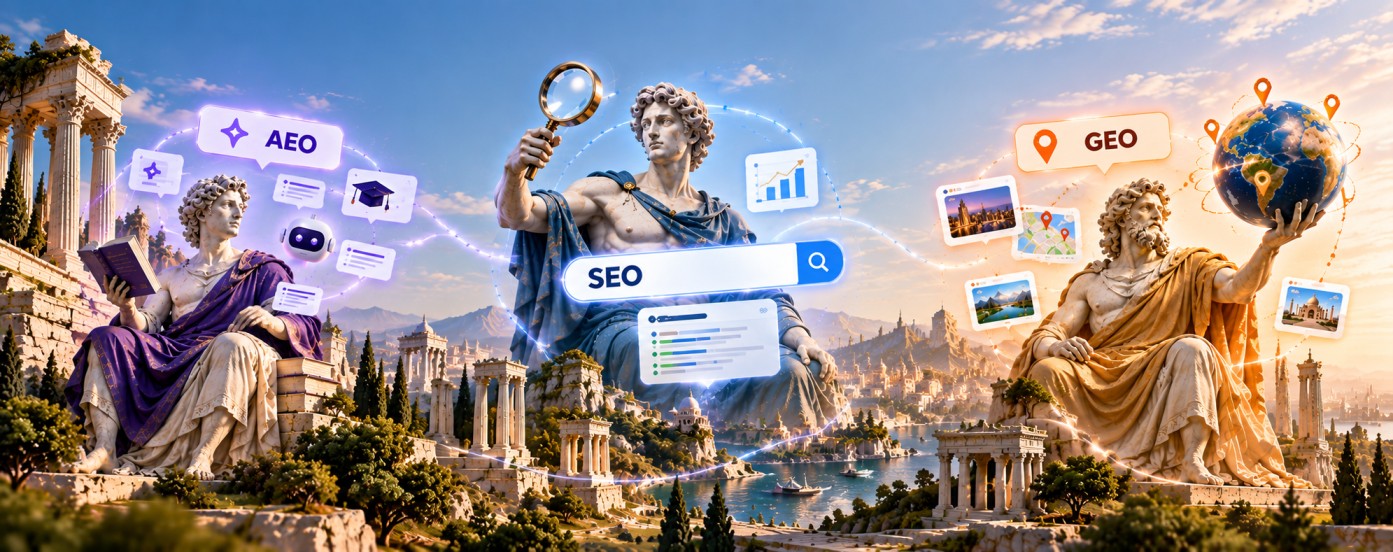
- SEO, AEO and GEO are not three competing strategies. They describe three places your business can show up.
- Google’s own 2026 guidance says optimizing for generative AI features is still, fundamentally, SEO.
- There is no agreed definition separating AEO from GEO. Even academic literature treats the terms as interchangeable.
- The underlying signals are shared, which is why most of the work counts for all three at once.
- The genuine change is that visibility increasingly depends on what exists about you elsewhere, not only on your own website.
- Publishing more content is the most common and most wasteful response to this shift.
THE VERDICT
What’s the short answer?
Asking which of SEO, AEO and GEO will matter in 2027 is a bit like asking whether you should invest in engines, wheels or steering. They are not alternatives. They are parts of the same machine, and most of the work that improves one improves the others.
That said, the split is not meaningless. Where you put your effort genuinely should change going into 2027, just not in the way most agencies selling these acronyms suggest.
Google itself makes the point plainly. In documentation published in 2026 titled Optimizing your website for generative AI features on Google Search, it states that optimizing for generative AI search is optimizing for the search experience, and thus still SEO.
So the useful question is not which acronym wins. It is which parts of the work now matter more than they used to. That is what this article answers.
THE DEFINITIONS
What does each acronym actually mean?
Each term describes a different outcome you are optimizing for.

SEO
Rank high enough that people click through to your site
AEO
Ensure your content appears directly on search results pages,
GEO
Be the source an AI names when it writes its own answer

All Three
Ensure your content is findable, readable, and trustworthy,
SEO (Search Engine Optimization) is the “original” art. Its objective is to optimize your pages so they appear at the top of the search results and attract visitors. The success metric is a click from a searcher to your page.
AEO (Answer Engine Optimization) focuses on the surfaces that provide answers rather than lists of links. These are the featured snippets, the knowledge panels, the voice assistants, and Google’s new AI Overviews. The success metric is having an answer on the page.
GEO (Generative Engine Optimization) optimizes the content so it shows up in the responses generated by AI tools like ChatGPT and Perplexity, Gemini, Claude, and Copilot. Success comes from naming your business as one of the sources that built the answer.
To hold the difference clearly in your mind, recognize that SEO aims to rank as a result, AEO seeks to be the answer, and GEO focuses on being the source from which the answer originates.
THE HONEST PART
Is the difference between AEO and GEO real?
There is no agreed definition separating these terms. As of early 2026, researchers had not established any consensus definition distinguishing them in the academic literature, and the industry uses the terms interchangeably. You will also see the same idea sold as AIO (artificial intelligence optimization), LLMO (large language model optimization) and simply AI SEO.
Where practitioners do separate them, the distinction runs roughly like this. AEO is the older idea, predating language models by about a decade, and it covers any system that returns an answer rather than a list. GEO is the newer, narrower layer concerned specifically with how a language model assembles a multi-source answer and which brands it names in the process.
That distinction is useful for thinking clearly. It is not useful as a reason to buy three separate services. If an agency offers you SEO, AEO and GEO as three products with three price tags, ask which specific tasks differ between them. Frequently the honest answer is: not many.
WHATS NEW
What has genuinely changed?
The clearest change is that answers increasingly arrive without a click. Over 60% of Google searches now end without the user visiting another website. Ahrefs measured a 58% drop in click-through rates for top-ranking content when an AI Overview appears up sharply from 34.5% the year before.
Meanwhile, people are searching in new places entirely. EMARKETER forecasts that 31.3% of the US population will use generative AI search in 2026. Back in 2024, Gartner predicted traditional search engine volume would fall 25% by 2026, a prediction that has broadly played out.
What the data shows
60%+
Of Google searches end without a click to another website
58%
Drop in click-through rate for top-ranking pages when an AI Overview appears
31.3%
Share of the US population expected to use generative AI search in 2026
~40%
Of AI Overview citations come from pages ranking in the top ten
Ranking has also stopped being the gate it once was. Roughly 40% of AI Overview citations come from pages ranking in the top ten, with about 70% from the top 100. In other words, page one still helps, but pages well outside it now get quoted regularly, which is genuinely good news for smaller businesses.
The deepest change, though, is about where visibility comes from. Traditional SEO was largely a first-party exercise: you improved your own website. Being cited by AI systems depends much more on how your brand appears across the wider web, in reviews, industry publications, forums, directories and other people’s content. You have less direct control over that, and it takes longer to build.
THE SHARED FOUNDATION
Where do the three overlap?
Everything starts with access. If a page cannot be crawled, it cannot rank, cannot become an answer, and cannot be cited. A page blocked by a firewall or hidden behind a login fails at all three at once, regardless of how good it is.
Then comes clarity. Content that answers a specific question completely, in plain language, with a clean heading structure, performs better everywhere. Search engines reward it, answer surfaces extract it more easily, and language models quote it more readily.
Structured data helps across the board too. Marking up your organization, products, articles and FAQs tells machines what your content means rather than leaving them to guess.
Finally, trust. Original data, clear authorship, evidence-backed claims and genuine expertise matter to all three systems. None of this is new advice. It has simply become harder to fake.
THE REAL DIFFERENCES
Where are they genuinely different?
Three differences are real and worth planning around.
01
The first is who your competitors are
In traditional search you compete against the other nine results. In a generated answer, the AI usually names two or three sources. Being fourth-best in search still gets you some traffic. Being fourth-best in an AI answer gets you nothing.
02
The second is where the work happens
SEO work happens mostly on your own website. GEO work happens substantially off it — in how often and how favourably your brand appears elsewhere. That changes who does the work, since it pulls in PR, community presence and partnerships rather than just a content team.
03
The third is which crawlers matter
Eligibility differs by surface. Googlebot governs Google’s search and AI features, while OAI-SearchBot supports ChatGPT’s search and PerplexityBot supports Perplexity. Blocking the wrong one quietly removes you from a platform while leaving the others untouched.
THE PRIORITY
Which one should you invest in first?
Here is the practical order, and it holds for almost every business going into 2027
01
Start by fixing access.
Ensure search and AI crawlers can access key pages, often overlooked due to security settings.
02
Then improve clarity on the pages that matter commercially.
Ensure search and AI crawlers can access key pages, often overlooked due to security settings.
03
Then publish something only you can publish
Your AI’s original figures and honest comparisons are unmatched by competitors..
04
Then work on presence beyond your own site
Industry reviews can distinguish businesses.
05
Finally, measure whether AI systems name you.
Measurement is essential to avoid guessing if anything worked.
THE MISTAKE
What is a waste of money?
Three things, and the first is by far the most common.
Publishing a hundred articles because someone said GEO needs content. This is the most frequent and most wasteful response to the shift. Research into generative engines has found that content volume strategies have little effect. What matters is how well each piece is structured, sourced and distributed, not how many pieces exist. A hundred thin articles also compete with each other, diluting the pages that were working.
Buying SEO, AEO and GEO as three separate retainers. Since the underlying signals overlap heavily, paying three times for largely the same work is an expensive way to be told the same things in different vocabulary.
Chasing tactics with no evidence behind them. Several widely-promoted techniques have little measurable effect. Before adopting any tactic, ask what evidence supports it and how the result would be measured. If neither question has a clear answer, it is a guess.
MEASUREMENT
How do you measure each one?
The three differ more in measurement than in method, which is one reason the distinction persists.
SEO measurement is familiar: rankings, impressions, clicks and conversions, all visible in standard analytics.
AEO measurement is harder, because the win is often a non-click. You can watch impressions rising while clicks fall, which usually means you are being shown but not visited. That pattern is frustrating to read but is not necessarily failure.
GEO measurement barely exists in standard tools at all. The practical approach is to ask the systems directly: take the ten questions a customer would realistically ask before choosing a business like yours, run them through ChatGPT, Perplexity and Google AI Mode on a schedule, and record which businesses get named. It is manual, it takes an afternoon, and it tells you more than any dashboard currently can.
Watch your direct and branded traffic too. Someone who reads your name inside an AI answer often arrives later through a route analytics attributes to nothing at all.
LOOKING AHEAD
What happens next?
Two things seem likely going into 2027.
The acronyms will probably consolidate. Terminology this unsettled rarely stays split, and with Google describing generative AI optimization as still being SEO, the most likely outcome is that these practices simply become part of what SEO means — much as mobile optimization did a decade ago.
The underlying shift, however, will keep deepening. More answers will be delivered without a click. More discovery will happen inside AI tools rather than on results pages. And as AI agents begin browsing and comparing on people’s behalf, being machine-readable will matter as much as being human-readable.
So the honest answer to which one matters in 2027 is this: the work matters, and the labels mostly do not. A business that is easy to find, easy to understand, well-regarded elsewhere and genuinely useful will do well across all three surfaces. One that treats them as three products to buy will spend more and learn less.
WHERE TO START
Finding out where you stand
Most businesses have never checked whether AI systems name them at all, which makes any strategy discussion premature.
That is what The Brihaspati Infotech’s free AI Readiness Audit is for. It looks at how ready your website and content are for AI systems, whether they can reach your pages, understand what you offer, and find enough there to quote. You get the findings whether or not you take the work further. The Brihaspati Infotech builds AI systems and helps businesses stay visible as search changes shape
The Brihaspati Infotech builds production AI systems, including the retrieval architectures that decide which sources a model draws on before it answers. That is the same problem described throughout this article, seen from the other side, which is why our recommendations come from how these systems actually select sources, rather than from guesswork about an algorithm.
Disclaimer: References to third-party products or companies are informational and do not imply affiliation, association, endorsement or partnership.