
 By
By 
- An AI agent does more than answer questions. It plans steps, uses tools, remembers context and hands off to a person when it should.
- AI is already mainstream in US classrooms: RAND found 54% of students and 53% of core subject teachers used it for school in 2025.
- Guidance has not kept up. Gallup found only 18% of US K-12 teachers receive formal written guidance on AI use.
- The FTC’s amended COPPA rule became fully enforceable on April 22, 2026, with penalties up to $53,088 per violation.
- Voice-based agents need extra care, because voiceprints now count as biometric personal information under COPPA.
- Start with one agent built around one job. It is faster to build, easier to test, and easier to get approved by a district.
THE BASICS
What is an AI agent in edtech?
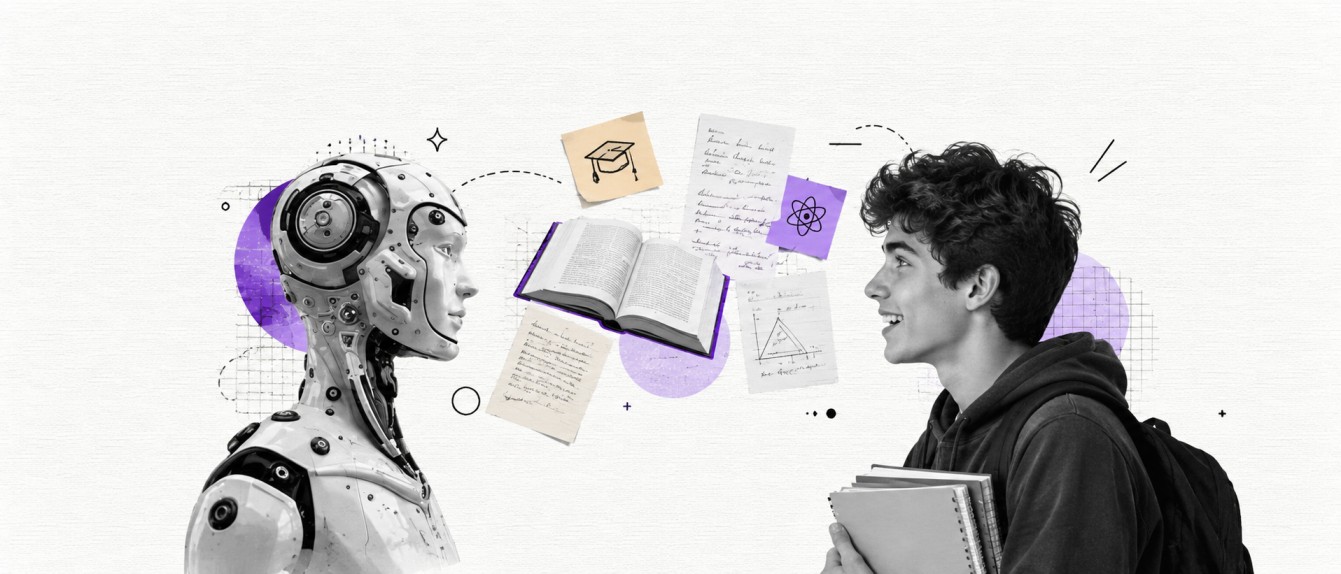
An AI agent in edtech is software that can carry out a learning or school task from start to finish, rather than just answering a single question. It understands what a student or teacher wants, decides on the steps, uses the right tools or data, and hands off to a human when a situation needs one.
That makes it different from a chatbot. A chatbot answers the question in front of it and waits. An agent can notice that a student keeps missing the same type of problem, pull up the related lesson, generate practice questions at the right level, check the answers, and then flag the pattern to the teacher.
So in plain terms: a chatbot talks, while an agent works.
For a US edtech company, that difference matters commercially. Schools and families already have free chatbots. What they will pay for is something that saves a teacher time or measurably helps a student — and that usually means an agent built around a specific job.
THE MOMENT
Why does 2026 matter for US edtech?
Three things came together in the US this year, and each one affects anyone building AI for education.
First, AI use in schools is now normal. RAND’s nationally representative surveys found that in 2025, 54% of students and 53% of English, math and science teachers used AI for school. That is an increase of more than 15 percentage points in just one to two years. Gallup’s research for the Walton Family Foundation found 60% of US public school teachers used an AI tool during the 2024–25 school year.
Second, guidance is far behind use. Gallup’s May 2026 findings show only 18% of US K-12 teachers receive formal written guidance on AI. RAND found only 35% of district leaders provide students with AI training. In that gap, teachers and districts are actively looking for tools they can trust.
Third, the rules just got stricter. The FTC’s amended COPPA rule, covering children under 13, became fully enforceable on April 22, 2026. Meanwhile, states have been issuing their own AI guidance — Vermont in January 2026, New York City Public Schools in March 2026, and Illinois in June 2026.
Put together, this creates a clear opportunity with a clear condition attached. Demand is real and growing. But US schools will increasingly buy only from vendors who can show their AI is safe, grounded and compliant.
There is also a trust gap worth knowing about. RAND found that 61% of parents believe more AI use could harm students’ critical-thinking skills, compared with just 22% of district leaders. An edtech product that ignores parent concerns may win a district contract and then lose the families.
USE CASES
What can AI agents actually do in edtech?
The most useful edtech agents focus on one clear job. Here are the ones delivering real value in 2026.
01
Tutoring agents
Help students work through problems using the course’s own material, adjusting difficulty as they go. The best ones guide rather than hand over answers.
02
Teacher assistant agents
Draft lesson materials, create practice sets, and suggest differentiated versions of an activity for students at different levels
03
Feedback agents
Give students first-pass feedback on writing or problem-solving, with the teacher keeping final say on grades
04
Language and accessibility agents
Translate, read content aloud, and support pronunciation practice. This matters a great deal in US schools, where many students are learning English
04
Admissions and enrollment agents
Answer prospective family questions, guide applicants through forms, and chase missing documents for schools, colleges and course providers.
04
Parent communication agents
Answer routine questions about schedules, assignments and school policies at any hour.
04
Course platform support agents
Help adult learners and professionals navigate a course, find the right module, and stay on track.
UNDER THE HOOD
How does an edtech AI agent work?
Every agent follows the same basic loop, and understanding it helps you design a good one.

It understands the request
The agent works out what the student or teacher is actually asking, including what they mean rather than just the words they typed.
Gathers what it needs.
It looks up the relevant lesson, the student’s recent work, or the school’s policy, whatever the task requires.

Decides and acts
It chooses the next step: explain a concept, generate a question, update a record, or send a notification.

Checks and escalates.
It judges whether it is confident enough to continue. When it is not, or when the situation is sensitive, it hands off to a teacher or staff member.
The second step is where most edtech agents succeed or fail. An agent that answers from general internet knowledge will teach methods, terms and standards that do not match the classroom. An agent that looks up the school’s own material first — a technique called retrieval-augmented generation — explains what the teacher actually taught. Enterprise platforms such as Azure OpenAI are often preferred for this in education, because they run inside a controlled environment rather than a consumer service.
That grounding step is the foundation every useful edtech agent is built on. Without it, even the most capable AI model teaches from general knowledge instead of your curriculum. With it, the agent stays consistent with what students are actually learning in class.
THE US RULES
What do the new COPPA rules mean for AI agents?
If your product may be used by children under 13 in the US, this section matters more than any other.
COPPA — the Children’s Online Privacy Protection Act — is a federal law enforced by the FTC. The FTC finalized major amendments on January 16, 2025, the first significant updates since 2013. Full compliance became mandatory on April 22, 2026, with no grace period.
The penalties are serious. Violations can reach $53,088 each, and because each affected child can count separately, the total can multiply quickly. The FTC has publicly named children’s privacy as a top enforcement priority for 2026.
Several changes directly affect AI agents:
01
Personal information now includes biometric identifiers
such as voiceprints and facial recognition data. That has major consequences for voice-based agents, covered in the next section.
02
Separate consent is required before sharing children’s data with third parties
If student input flows to an outside AI provider, you need to understand exactly what that provider receives and keeps.
03
Data retention is now limited.
You need a written retention policy and must delete children’s data once it is no longer needed for its purpose.
04
School consent still works, but only for educational purposes.
Schools can consent on a parent’s behalf, but only for the school-authorized educational use, not for anything commercial.
One more point catches many founders out. Following FERPA does not exempt you from COPPA. FERPA governs student education records held by schools. COPPA governs what you, as the operator, collect from children. You usually need to satisfy both.
State law can go further still. Illinois and Texas, for example, have their own biometric privacy laws that may exceed COPPA’s requirements.
This is general information, not legal advice. Talk to a qualified attorney about your specific product before launch.
SPECIAL CASE
Why are voice agents a special case?
Voice makes edtech agents far more useful. Young children can speak before they can type well. Language learners need to hear and practice pronunciation. Students with reading difficulties often do better listening than reading.
However, voice creates a specific compliance issue under the updated COPPA rule. Because voiceprints are now treated as biometric personal information, a voice agent that records or processes a child’s voice is handling some of the most sensitive data the rule covers.
That does not mean voice is off-limits. It means voice needs to be designed carefully from day one:
1
Decide whether you need to store audio at all, or only process it in the moment
2
Know exactly where audio goes and whether any provider keeps it
3
Set short, written retention periods for anything you do keep
4
Make sure consent covers voice specifically, not just general use
The key lesson is simple: designing privacy into a voice feature from the start costs far less than fixing it after launch, when real student recordings may already be stored.
THE MOMENT
What will school districts ask you?
US school districts have become much more careful buyers, and for good reason. Education is a heavily targeted sector: Check Point reported schools faced an average of 4,388 cyberattacks every week in the second quarter of 2025, and Comparitech reported ransomware groups stole 3.89 million records from US schools in 2025.
So expect districts to ask detailed questions before they sign anything:
Where does student data live?
Named hosting region and provider.
Does the AI train on it?
A clear yes or no, in writing
Can teachers see conversations?
A review or audit view
Can you delete on request?
A documented deletion process and timeline
Vendors who can answer these clearly move through procurement faster. Vendors who cannot often stall for months, or never get approved at all.
The US Department of Education has also confirmed, in a July 2025 guidance letter, that districts may use federal grant funds for AI, provided the use aligns with existing requirements including FERPA. That makes compliance a selling point, not just a legal box: it directly affects whether a district can pay for your product.
BUILDING IT
How do you build an edtech AI agent?
The order matters more than the technology. Here is the sequence that works.
01
Pick one job.
Start with a single agent that does one thing well, tutoring in one subject, or enrollment questions for one school. Broad “do everything” agents are harder to test and harder to sell.
02
Settle compliance first
Decide your age range, data flows, retention rules and consent approach before building anything. For under-13 users, this shapes the whole architecture.
03
Gather your content
An edtech agent is only as good as the material it draws on. Collect and clean the lessons, documents and policies it will use.
04
Ground every answer
Connect the agent to that material so it answers from your content rather than general knowledge
05
Design the handoffs.
Decide exactly when the agent passes a student to a teacher, for example, when it detects distress, repeated confusion, or anything outside its scope
06
Give teachers visibility.
Teachers should be able to see what students asked and what the agent said. This builds trust with schools and catches problems early.
07
Pilot small, then expand.
Launch with one class or one course, measure results, and fix weak spots before scaling.
08
Budget for running costs.
Every student interaction uses model and, for voice, speech services. Work out your cost per student before you set your price
WHAT GOES WRONG
Where do edtech AI projects go wrong?
Four mistakes come up again and again.
01
Building before checking compliance
Teams build a working product, then discover it cannot pass district procurement or meet COPPA. Rebuilding the data layer late is slow and expensive.
02
Using general knowledge instead of course material
An ungrounded agent teaches different methods and terms than the teacher, which confuses students and frustrates schools..
03
Giving answers instead of guiding
An agent that simply solves homework tends to worry parents and teachers, especially given how many parents already fear AI will weaken critical thinking.
04
Forgetting operating costs
A product that works at pilot scale can become unaffordable when thousands of students use it daily.
WORKING WITH US
Why The Brihaspati Infotech
The Brihaspati Infotech builds AI agents and learning platforms for education businesses, including tutoring, voice and multilingual systems grounded in real course material. For US edtech companies, that work starts well before any code is written. The team helps decide which agent to build first, plans student data handling around COPPA, FERPA and state privacy rules, and connects the agent to your own content so it teaches what your curriculum teaches. As a result, the finished product is ready for the questions district procurement teams actually ask.
A good first step is the free AI Consultation. Get ideas on how ready your website and content are for an AI-first world, including whether AI systems can understand your product and recommend it when schools, teachers and parents go looking. That matters twice over for edtech companies. The same clear, well-structured content that helps AI search engines find you is also what an AI agent needs to give students accurate answers.
Disclaimer: References to third-party products or companies are informational and do not imply affiliation, association, endorsement or partnership.